
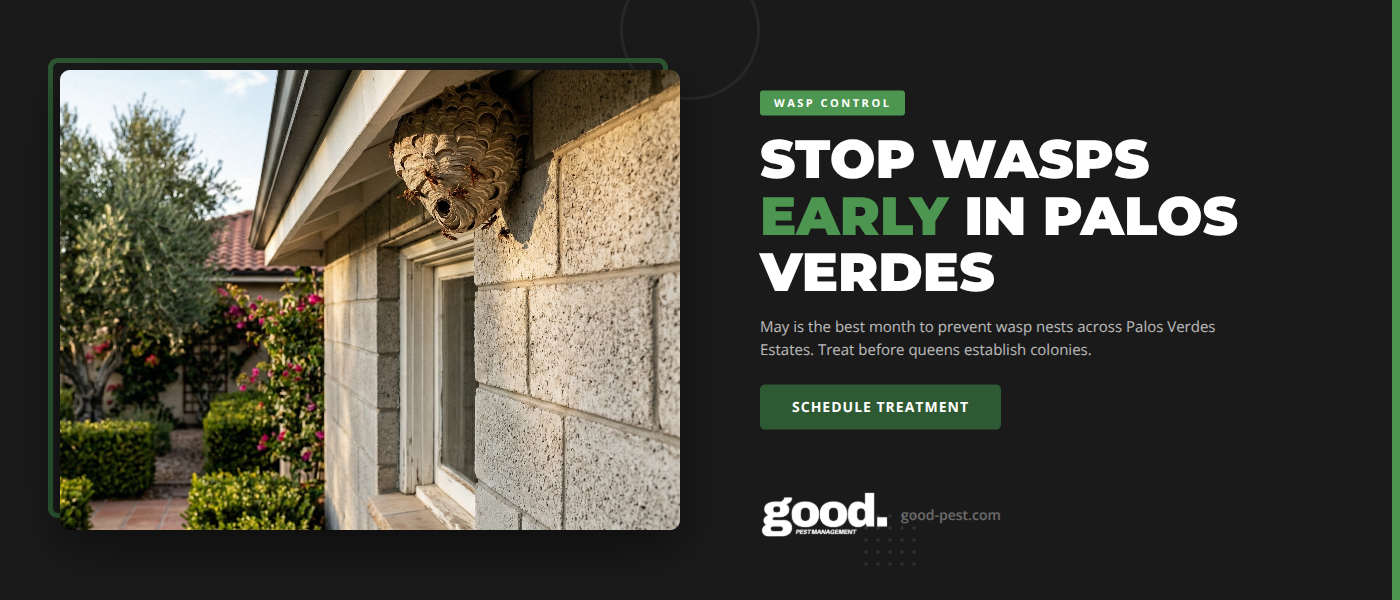
Spring along the Palos Verdes Peninsula peaks in May — and so does paper wasp queens building nests across Palos Verdes Estates. If you've spotted a wasp hovering near an eave or examining a porch light, that's almost certainly a foundress queen scouting her first comb. Acting now, before that comb has more than a handful of cells, is the difference between a five-minute removal and an aggressive nest of dozens of workers in August.
At Good Pest Management, we serve Palos Verdes Estates and the broader South Bay year-round, and we know how predictable this nesting cycle is along the coastal hillsides. This guide covers why May is the right month to act, where wasps build first, and the practical steps that keep summer comfortable. Wasp pest control in Palos Verdes Estates is one of the most time-sensitive pest issues we treat — and the earlier in the season, the easier the outcome.
Paper wasps overwinter as fertilized queens, sheltering inside attic cavities, garden sheds, hollow tree limbs, stacks of patio cushions, and the protected undersides of roof tiles. According to the UC Statewide Integrated Pest Management Program, queens emerge from dormancy as soon as daytime temperatures climb consistently above 50°F — which along the Peninsula happens reliably by mid-March in warm years and by early April in cooler ones. By May, the foundress queens have surveyed potential nesting spots, started chewing wood pulp into paper, and laid the first round of eggs.
That early-May nest is small — usually a single hexagonal comb with five to twenty cells, attached to a stem of paper no thicker than a pencil. There are no workers yet; the queen is doing all the foraging, building, and defending alone. From late May through July, those eggs hatch into worker wasps and the colony expands rapidly. A mature paper wasp colony can reach 50 to 200 workers by late summer, and yellow jacket nests can hit 4,000 to 5,000 individuals. Every nest you handle in May is one you don't have to face — at far higher risk and far higher cost — in August. Wasp prevention in Palos Verdes Estates is genuinely a matter of weeks, not months.
Three groups account for nearly every stinging-insect call we get on the Peninsula:
Honey bees, carpenter bees, and the occasional bumblebee also turn up during inspection, but these are pollinators we don't treat — we recommend a local beekeeper for relocation instead.
Palos Verdes Estates homes — with their generous eaves, exposed wood beams, tile roofs, and Mediterranean architecture — offer some of the best wasp real estate in Southern California. The most common first-nest spots we find:
A walkaround once a week through May, with a flashlight aimed up under eaves and into the corners of patio covers, catches most paper wasp starters before workers emerge.
The case for handling wasps in May rather than July comes down to colony size and defense behavior. In May, a paper wasp nest typically has only the foundress queen present — focused on building and laying, not defending. A small starter comb can be removed in seconds with a long-handled scraper, with no workers waiting to retaliate.
By July, that same colony has fifteen to forty active workers patrolling the nest, and defensive behavior kicks in within feet of the comb. Yellow jacket nests are dramatically worse — a mid-summer ground colony can produce hundreds of defenders within seconds of being disturbed. People with allergies, children, pets, landscapers, and pool service techs all face higher risk.
May visits are also lighter touch from a treatment standpoint. We treat fewer locations, use smaller volumes of product, and don't need the protective equipment a mid-summer yellow jacket job often requires. The result is less disruption, lower cost, and a property that stays comfortable through the months you want to use the patio.
A few consistent habits in May and early June dramatically reduce wasp pressure for the rest of the year:
Inspect weekly through May. Walk the perimeter with a flashlight aimed up — eaves, soffits, patio covers, deck undersides, mailboxes, light fixtures, BBQ covers, and play structures. Catch starter combs while there's only one queen present.
Knock down small starters with a long-handled tool. If the comb is no bigger than a quarter and you don't see workers, an early-evening sweep with a long pole knocks it loose. Wear long sleeves, pants, closed shoes, and gloves; keep pets and children inside.
Seal entry points. Look for gaps in stucco, missing soffit screens, lifted roof tiles, unscreened attic vents, and openings around utility penetrations. Yellow jackets in particular exploit these to nest inside walls and attics.
Cover irrigation valve boxes and trash cans tightly. Both are common yellow jacket nesting and feeding sites.
Manage outdoor food and drinks. The UC IPM program notes yellow jackets are strongly drawn to sugary drinks and protein scraps. Use covered cups, clean grills after use, and bring pet food bowls indoors.
Trim back vegetation against the house. Bougainvillea, ivy, and dense ornamentals pressed against stucco give wasps cover and access to sheltered voids.
Skip the urge to swat solo foragers. Wasps on flowers or water rarely sting unprovoked — calm avoidance keeps the situation from escalating.
If you find a nest larger than a golf ball, hear buzzing inside a wall, or see steady wasp traffic in and out of the same ground spot, stop the DIY approach and bring in a professional.
Some situations are clear cases for a licensed pest control technician rather than a homeowner with a long stick. Call us when:
Our Good Pest Management technicians are licensed, insured, and members of the National Pest Management Association. We use eco-friendly, pet-friendly products and treatment methods designed to be gentle around your household — applied directly to the nest and entry points rather than broadcast across the yard. Every service is backed by our 100% Satisfaction Guarantee. If wasps return between scheduled visits, we return too.
Beyond the weekly inspection routine, a few longer-term projects harden a Palos Verdes Estates property against wasps year over year:
Paper wasp queens begin emerging from winter dormancy as soon as Peninsula daytime temperatures climb consistently above 50°F — typically mid-March to early April. Active nest building peaks through May, colonies expand quickly through June and July, and stinging incidents are most common from late July through September. Mild coastal winters keep some species mildly active year-round.
Yes. We use eco-friendly, pet-friendly products designed to be gentle around animals, children, and household plants. Treatments are applied directly to the nest and entry points rather than broadcast across the yard, and we'll walk you through any short post-treatment guidance specific to the product used.
For a starter paper wasp comb smaller than a quarter, in May, with no workers visible, a long-handled sweep at dusk is reasonable if you're wearing protective clothing. For anything larger, anything inside a wall or in the ground, or anytime you hear active buzzing, stop and call a professional. Yellow jacket colonies in particular can produce hundreds of defenders within seconds of being disturbed.
For most Palos Verdes Estates properties, we recommend a spring inspection in April or early May, followed by quarterly visits through the active season. Properties with a history of yellow jacket activity or those that border canyons and open space benefit from a recurring plan that covers wasps alongside other South Bay pests.
May is the moment to get ahead of wasp season in Palos Verdes Estates. With consistent inspection and the right professional support when a nest gets out of reach, you can keep your patio, eaves, and kids' play area comfortable through the active months. Our team is here to help — backed by our 100% Satisfaction Guarantee and a commitment to eco-friendly wasp pest control in Palos Verdes Estates, CA. Contact us today to schedule your inspection.